
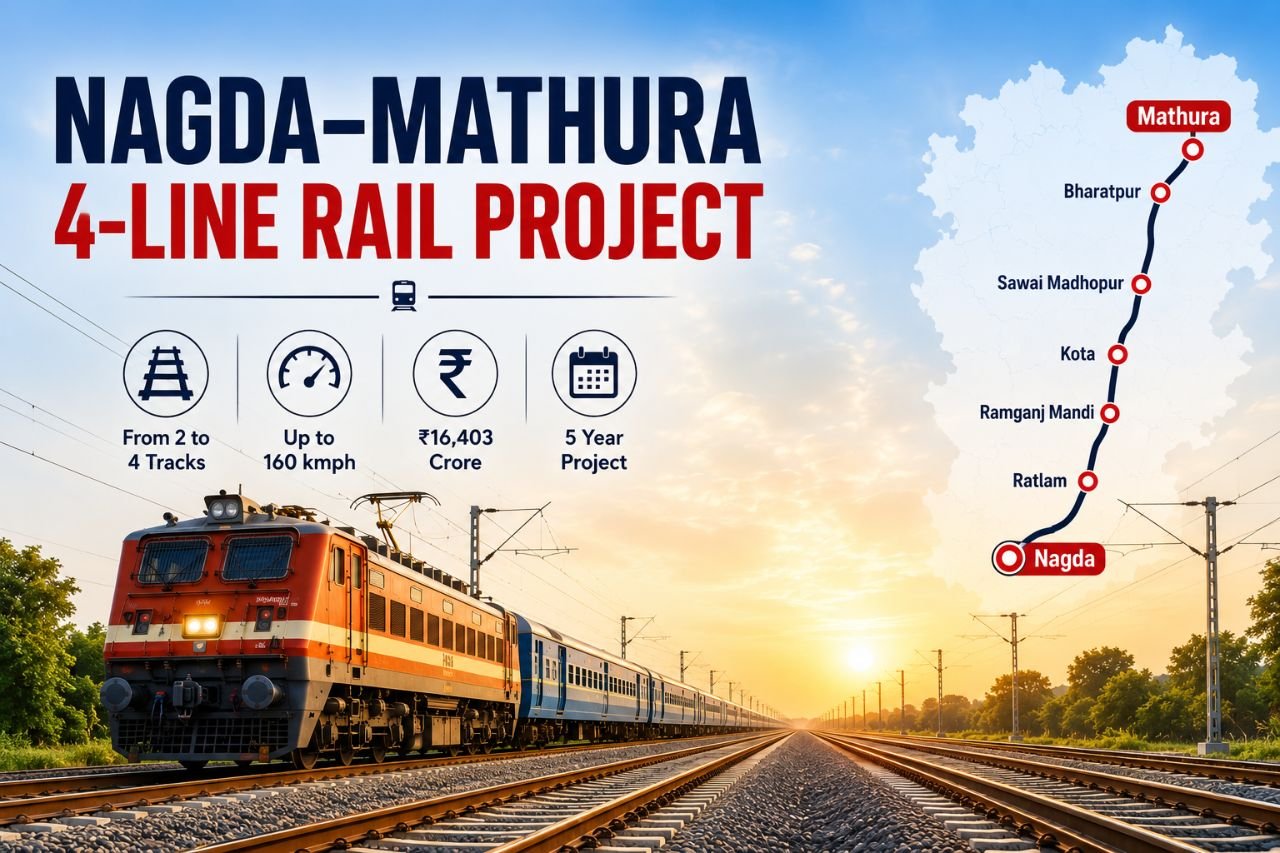
Nagda Mathura Railway Line to Get Third and Fourth Tracks
Indian Railways is set to significantly expand capacity on the busy Delhi Mumbai railway corridor, with the existing two-track section between Nagda and Mathura being upgraded through the construction of third and fourth railway lines.
The project is expected to be a major infrastructure boost for passenger and freight movement across Madhya Pradesh, Rajasthan and Uttar Pradesh. The Nagda Mathura section is an important part of the Delhi Mumbai High-Density Network and carries heavy passenger as well as freight traffic.
The development was highlighted in a recent newspaper report, while the Cabinet Committee on Economic Affairs (CCEA) had already approved the Nagda–Mathura third and fourth line project in May 2026. According to the Government of India, the project has an estimated cost of ₹16,403 crore and covers approximately 567.86 km.
Nagda Mathura 4-Line Project: Key Details
Here are the major details of the project:
| Project Detail | Information |
|---|---|
| Railway Section | Nagda Mathura |
| Existing Lines | 2 |
| New Lines | 3rd and 4th |
| Total Route Length | Approx. 567.86 km |
| Estimated Cost | ₹16,403 crore |
| Project Duration | 5 years |
| States Covered | Madhya Pradesh, Rajasthan and Uttar Pradesh |
| Corridor | Delhi Mumbai High-Density Network |
| Planned Speed | Up to 160 kmph on the upgraded infrastructure |
The official Cabinet brief identifies the route length as about 568 km, with the project planned for completion in five years.
Which Stations and Areas Will Benefit?
The Nagda Mathura corridor passes through several strategically important railway locations. The route connects major stations and cities including:
- Nagda Junction
- Ratlam region
- Ramganj Mandi
- Kota Junction
- Sawai Madhopur
- Gangapur City
- Bayana Junction
- Bharatpur Junction
- Mathura Junction
The project will therefore strengthen rail connectivity across important parts of Madhya Pradesh, Rajasthan and Uttar Pradesh.
The official project document lists districts including Ujjain, Ratlam and Mandsaur in Madhya Pradesh; Jhalawar, Kota, Bundi, Tonk, Sawai Madhopur, Karauli and Bharatpur in Rajasthan; and Mathura in Uttar Pradesh.
Why Is the Nagda Mathura Railway Project Important?
The Nagda Mathura section is strategically important because it forms part of the Delhi–Mumbai High-Density Network. The corridor handles both passenger trains and large volumes of freight.
The addition of two railway lines will allow trains to be handled more efficiently, reducing pressure on the existing tracks.
According to the Government of India, the three multitracking projects approved in May 2026 including Nagda Mathura are expected to improve mobility, operational efficiency and service reliability while helping reduce congestion.
More Railway Lines Means More Train Capacity
At present, trains travelling between Nagda and Mathura have to operate on the existing two-line infrastructure. As traffic increases, the availability of additional tracks becomes increasingly important.
With four tracks, Indian Railways will have greater flexibility to operate:
- Passenger trains
- Superfast and express trains
- Freight trains
- Special trains during festivals
- Additional services during peak travel periods
This could make it easier for Indian Railways to increase train frequency in the future without putting the same level of pressure on the existing tracks.
160 Kmph Speed Potential on the Upgraded Route
One of the most notable points highlighted in the newspaper report is the plan to support higher train speeds of up to 160 kmph after the infrastructure upgrade.
However, passengers should understand that the construction of additional tracks does not automatically mean that every train will immediately run at 160 kmph. Actual operating speeds depend on track geometry, signalling, rolling stock, safety systems, level crossings, bridges and other railway infrastructure.
Indian Railways has been progressively upgrading important routes for higher sectional speeds. The Delhi Mumbai corridor is also among the routes where modern railway safety and signalling systems are being implemented.
The Government of India has reported that Kavach 4.0 has already been commissioned on major portions of the Delhi Mumbai route, including the Palwal Mathura Nagda section.
New Bridges, Signalling and Safety Infrastructure
The newspaper report also highlights extensive infrastructure work associated with the project, including bridges, railway overbridges/underbridges and modern signalling arrangements.
The project is expected to incorporate modern railway infrastructure and Kavach-compatible safety systems, helping Indian Railways improve both capacity and operational safety.
This is particularly important on a high-density route where passenger and freight trains operate in large numbers.
Major Boost for Freight Trains
The project is not only about passenger trains.
The Nagda Mathura route is an important freight corridor for commodities such as coal, foodgrains, cement, petroleum products, iron and steel, fertilisers and containerised cargo.
The Government of India expects the three approved multitracking projects together to generate additional freight-handling capacity of around 60 million tonnes per annum.
For the Nagda Mathura section specifically, additional tracks should help freight trains operate with fewer conflicts with passenger services.
This can improve logistics efficiency for industries located across central and northern India.
Better Connectivity for Tourists and Pilgrims
The project could also benefit tourism and pilgrimage travel.
The wider multitracking programme is expected to improve rail connectivity to important destinations such as Mathura, Vrindavan, Ranthambore National Park, Keoladeo National Park, Kuno National Park and Mahakaleshwar, among others.
For travellers, better line capacity can eventually translate into more reliable train operations and improved options for planning journeys.
When Will the Nagda Mathura Four-Line Project Be Completed?
The official Cabinet brief gives the project duration as five years.
The newspaper report also states that construction is expected to be completed within five years from the date of project approval.
As with other large railway infrastructure projects, individual sections may progress at different speeds depending on construction requirements, bridges, signalling, land and other project-related factors.
Therefore, passengers should not expect the entire route to become four-line simultaneously.
What Does This Mean for Train Passengers?
For passengers, the most important potential benefits will be greater railway capacity, reduced congestion and improved operational flexibility.
Once the additional tracks become operational, Indian Railways should have more room to manage passenger and freight traffic independently.
This could help support:
- More trains on the Delhi Mumbai route.
- Better management of freight and passenger services.
- Reduced congestion on busy sections.
- Improved operational reliability.
- Scope for higher sectional speeds.
- Better connectivity between major cities and tourist destinations.
The project is therefore not simply a track expansion. It is part of a broader effort to strengthen one of India’s most important railway corridors.
Nagda Mathura Railway Project: A Major Step for Indian Railways
The Nagda Mathura third and fourth railway line project represents a major investment in the capacity of the Delhi Mumbai rail network.
With an estimated investment of ₹16,403 crore, a route length of approximately 567.86 km and a five-year implementation period, the project is expected to strengthen passenger and freight movement across Madhya Pradesh, Rajasthan and Uttar Pradesh.
The addition of two new tracks will give Indian Railways greater capacity to handle future traffic growth while supporting modern signalling, safety and higher-speed railway infrastructure.
For regular passengers, freight operators and railway enthusiasts, the project is an important development to watch as Indian Railways continues its transition towards a higher-capacity, faster and more modern railway network.
Frequently Asked Questions
What is the Nagda Mathura railway line project?
The Nagda Mathura project involves constructing the third and fourth railway lines along the existing route, converting the corridor from a two-line to a four-line railway section.
What is the length of the Nagda Mathura railway project?
The approved project covers approximately 567.86 km between Nagda and Mathura.
What is the cost of the Nagda Mathura third and fourth line project?
The estimated cost is approximately ₹16,403 crore.
Will trains run at 160 kmph on the Nagda Mathura route?
The infrastructure is being developed with higher-speed operation in mind, and the newspaper report highlights a 160 kmph speed potential. Actual train speeds will depend on the completed infrastructure, signalling, safety requirements and rolling stock.
Which states will benefit from the project?
The project covers parts of Madhya Pradesh, Rajasthan and Uttar Pradesh.
When is the project expected to be completed?
The official Cabinet brief specifies a five-year project duration.
Why is the project important for the Delhi Mumbai railway route?
Nagda Mathura is an important section of the Delhi Mumbai High-Density Network. Adding two tracks will increase capacity and help Indian Railways handle growing passenger and freight traffic more efficiently.
Editorial Note: The project figures in this article have been cross-checked with Government of India/PIB information. The 160 kmph operating-speed reference is presented as an infrastructure/speed potential rather than a guarantee that every train will operate at 160 kmph.
