
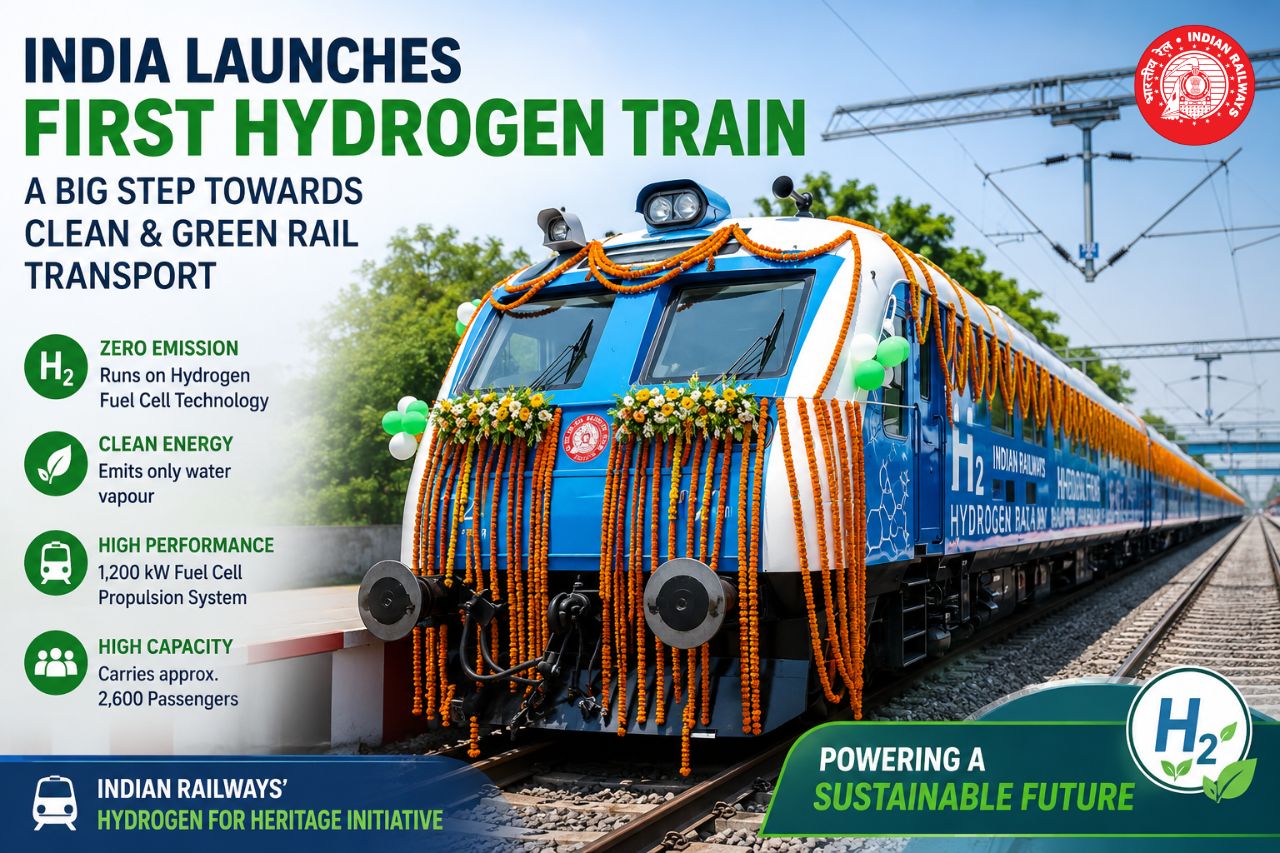
India has taken a significant leap towards sustainable mobility with the launch of its first indigenous hydrogen-powered train, marking a milestone in the country’s journey towards cleaner and greener transportation. Flagged off by Prime Minister Narendra Modi from Jind, Haryana, the train is part of Indian Railways’ ambitious “Hydrogen for Heritage” initiative, aimed at reducing dependence on fossil fuels while promoting zero-emission rail travel.
As countries across the globe explore alternative fuels to tackle climate change, India’s entry into hydrogen-powered rail technology places it among a select group of nations including Germany, China, and Japan that are investing in hydrogen-based transportation.
What Is a Hydrogen Train?
A hydrogen train is a railway vehicle that uses hydrogen as its primary fuel source instead of diesel. Most modern hydrogen trains are powered by hydrogen fuel cells, which generate electricity through a chemical reaction between hydrogen and oxygen.
Unlike conventional diesel locomotives, hydrogen trains do not burn fuel. Instead, electricity produced by the fuel cells powers electric traction motors, while water vapour and heat are the only direct by-products, making the technology an environmentally friendly alternative to fossil-fuel-powered trains.
Rail vehicles powered by hydrogen are collectively known as Hydrail, a term introduced in 2004 to describe hydrogen-powered railway systems.
How Does a Hydrogen Train Work?
The working principle of a hydrogen train is relatively simple:
- Hydrogen is stored in high-pressure tanks onboard the train.
- Oxygen from the surrounding air enters the fuel cell.
- Inside the fuel cell, hydrogen reacts with oxygen through an electrochemical process.
- This reaction generates electricity, which powers the train’s electric motors.
- The only direct emission is water vapour, making the train virtually pollution-free during operation.
Most hydrogen trains also include lithium-ion batteries or supercapacitors that store excess energy generated during braking and provide additional power during acceleration, improving efficiency while reducing hydrogen consumption.
Why Hydrogen Is the Future of Rail Transport
Hydrogen has emerged as one of the most promising clean energy sources for transportation.
Some of its key advantages include:
- Zero tailpipe emissions, producing only water vapour.
- Reduced dependence on diesel fuel.
- Suitable for non-electrified railway routes, where installing overhead electric lines is expensive.
- Quieter operation compared to diesel locomotives.
- Supports national and global carbon reduction goals.
The environmental impact, however, depends on how hydrogen is produced. Green hydrogen, generated using renewable electricity through electrolysis, produces almost no carbon emissions. In contrast, hydrogen produced through natural gas reforming still emits greenhouse gases, although significantly less than diesel.
Global Success Stories
Hydrogen trains are already proving their potential in several countries.
Germany became the first nation to introduce the Coradia iLint, developed by Alstom, into commercial passenger service in 2018. The train operates entirely on hydrogen fuel cells, emitting only steam and condensed water while significantly reducing noise pollution.
The United Kingdom also introduced the HydroFLEX, a hydrogen-electric hybrid train developed from a converted Class 319 unit, combining hydrogen fuel cells with lithium-ion batteries to deliver cleaner rail transport.
These successful projects have encouraged several other countries to invest in hydrogen rail technology for both passenger and freight operations.
India’s First Hydrogen Train Begins Its Journey
India has now officially joined the global hydrogen rail movement with the launch of its first domestically developed hydrogen-powered passenger train.
The train was flagged off from Jind Railway Station in Haryana and will initially operate on the Jind–Sonipat route under Northern Railway. The project forms part of Indian Railways’ Hydrogen for Heritage programme, which aims to introduce clean-energy trains on routes where electrification may not be economically viable.
The Hydrogen Multiple Unit (HMU) has been developed and manufactured by the Integral Coach Factory (ICF), Chennai, by converting an existing diesel-electric train into a hydrogen fuel-cell-powered train.
Key Features of India’s Hydrogen Train
India’s first hydrogen-powered train comes equipped with several advanced features:
- Two hydrogen-powered driving cars and eight passenger coaches.
- Twin 1,200 kW hydrogen fuel-cell propulsion systems.
- Capacity to carry approximately 2,600 passengers.
- Maximum design speed of 110 km/h, with current operational speed limited to 75 km/h.
- Advanced safety systems for hydrogen leak detection and monitoring.
- Hybrid energy system combining hydrogen fuel cells with battery storage for improved efficiency.
Built with Indigenous Innovation
The project represents a major achievement for India’s railway engineering ecosystem.
The hydrogen train has been developed by the Research Designs and Standards Organisation (RDSO) under the Ministry of Railways, while manufacturing was carried out by the Integral Coach Factory in Chennai.
The hydrogen fuel-cell propulsion system has been supplied by Ballard Power Systems, while BFG India contributed lightweight fibre-reinforced components for the train’s aerodynamic design and interiors.
To support operations, Indian Railways has established dedicated hydrogen production, storage and refuelling infrastructure at Jind, capable of storing up to 3,000 kg of hydrogen. The hydrogen generation system includes a proton exchange membrane (PEM) electrolyser supplied by GreenH Electrolysis.
Why This Launch Matters
The introduction of India’s first hydrogen-powered train is far more than a technological milestone.
It demonstrates the country’s commitment to:
- Reducing greenhouse gas emissions.
- Promoting green hydrogen under the National Green Hydrogen Mission.
- Developing indigenous clean transportation technologies.
- Lowering diesel dependence on non-electrified railway routes.
- Supporting India’s long-term target of achieving net-zero emissions by 2070.
Hydrogen trains could eventually become an attractive solution for heritage railways, hill routes and rural sections where full electrification remains economically challenging.
Challenges Ahead
Despite its promise, hydrogen rail technology still faces several challenges.
Producing green hydrogen remains expensive, while building hydrogen production plants, storage facilities and refuelling infrastructure requires substantial investment. Fuel-cell systems also continue to cost more than conventional diesel technology.
However, with continuous advancements in hydrogen production and fuel-cell efficiency, costs are expected to decline over the coming years, making wider deployment increasingly feasible.
Conclusion
India’s first hydrogen-powered train represents a historic step towards sustainable rail transportation. By embracing hydrogen fuel-cell technology, Indian Railways is paving the way for cleaner, quieter and more energy-efficient mobility.
While hydrogen trains are unlikely to replace electric railways on heavily trafficked routes, they offer a practical and environmentally friendly alternative for non-electrified sections where diesel has long been the only option. As hydrogen infrastructure expands and green hydrogen production becomes more affordable, India’s hydrogen train initiative could become the foundation for a new generation of zero-emission rail travel.
